

Welcome back! This weeks' essay is about the tiring topic of "taste". But I am tackling it from a slightly different perspective this time, hopefully a practical one for you.
Before we get into it, a couple updates for you:

The new mymind iOS app
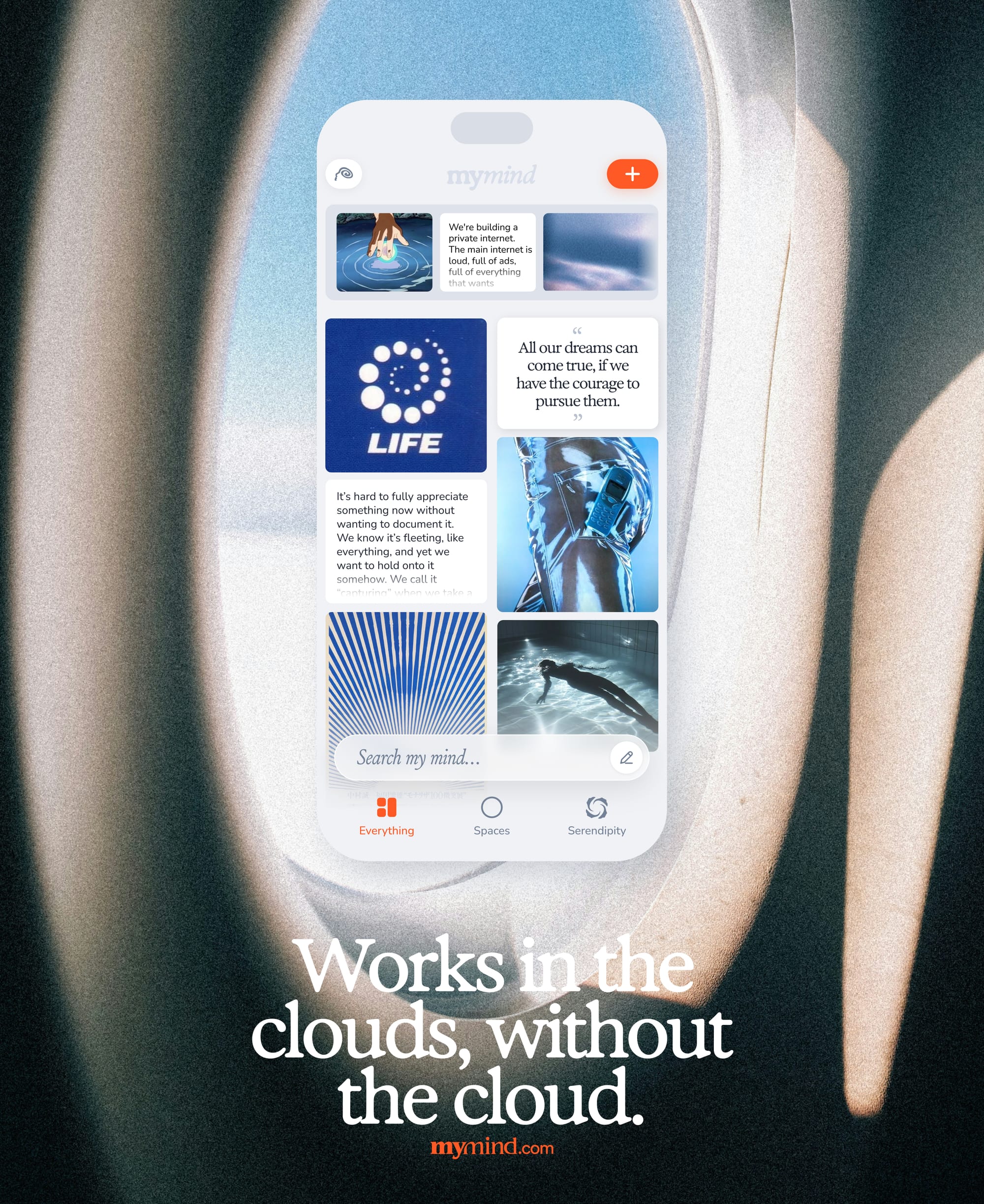
Yes, the new mymind iOS app is LIVE for everyone now! In fact, a new big update shipped last week. The new app is completely re-developed from the ground up. It's fully native, blazing fast and a lot of fun to use.
Now local first and built around offline support. This means you can use it in the clouds, but without the cloud. Or inside a bunker. Or deep down while diving in the ocean. Whatever hobbies you may have, it is always with you.
What's next? Our native MacOS app, in fact the beta is launching this week! (Android overhaul is coming next)
Nobody learns good taste by being told
If you've been on social media lately, you may have noticed that the "Taste" topic is circulating again. But this time, even more people are jumping into the conversation as there's mounting pressure on designers and creatives to justify their relevance.
I'm the first to admit, "Taste" in the general sense is certainly becoming one of the differentiating factors in a world where everyone can do everything, where everyone can copy everything, and where nothing is truly sacred anymore.
What I disagree with, is the general definition of what people think "Taste" is. Most people think its about certain aesthetics, many even believe there's a recipe to it, and even many more claim to have "it" more than their neighbor. It's a funny spectacle and understandably born out of the desperation of our current times.
We all seem to be a little lost right now.
And I don't want to be adding more noise to it. I won't attempt to define "taste" because everyone's sense and understanding of it is so entirely different.
Instead, I want to tackle this topic from a different perspective.
Yes, "Having good taste" (as defined by yourself) is a good first step, but the real difference is being made by being able to pass it on. To articulate it, to communicate it and possibly even visualize it.
This is what this essay is about.
If the people around you don't share the same understanding of taste or can't understand it, then your taste doesn't count much and won't get you very far.
The meaningful work is transferring it and making it understandable to others. This is real work, and often why a gap between those with and those without taste exists.
What does this mean for designers or marketers?
You can teach taste by teaching people how to see what you see, how to compare and how to judge, by themselves. Taste, once understood and embodied is largely developed through repeated exposure and attention.
But the important part is the difference between recognizing something is good and understanding WHY it is good. This is how good taste becomes more than just a passing trend.
If we allow ourselves to generalize for a moment, people tend to fall into three groups.
The first, and largest, group doesn’t have particularly good taste. Not because they’re incapable of it, but because they don’t care much, or because their time and attention go elsewhere, often for perfectly good reasons.
The second group shows good taste, but borrows it. They follow the right brands and tastemakers and adopt their choices. They exhibit good taste without really embodying it. That’s still worth something.
The third group embodies it. Every decision they make is deliberate and informed down to the last detail, and they’ll gladly explain each one. They know not only what’s good, but why it’s good, because they’ve done the work to find out for themselves.
What does this mean in detail?
1. Expose people to better things. You can't develop personal taste without having references and opposites to judge for yourself. Show people, and do it all the time. If you want to convince someone of your OWN taste, which may or may not be objectively better than the average, then you need to come up with strategies to give people new reference points so they understand where you're coming from. Only preaching it won't help.
2. Teach people to compare. Put two things side by side and ask them what makes one better over the other. You can't drill it into people, they have to *truly* understand it themselves from their own judgment and perspective. Once people spot the difference at their own will, that's when they start spotting it everywhere.
3. Explain people your reasoning, your values. You can't just say "this coffee is bad" to people who love Starbucks, because that teaches people very little and they will always resort back to "bad coffee" because that's all they know, and just because you said so doesn't change that fact. Explain exactly every detail, why it matters, what would improve it etc... involve them into everything. Explain yourself, explain why each detail matters and what would improve it. Over time people make their own verdict, because they fully absorbed the reasoning behind it.
4. Help people develop their own judgment. Ask them for THEIR opinion before giving yours. Give them enough context and freedom, authority etc. to make their own informed judgment. You'll be surprised how often people don't even have their own judgment because they just go with the flow and never think about something in detail. You will also be surprised how many people already have good taste, and once they are allowed to explore it themselves in an environment that gives them the right tools to do so. How you help them do this is where the difference is being made. Give them a choice and let them defend it. You can almost see how their thought process changes as they verbalize it themselves.
To put it simple: Don't teach people what to like. Don't teach people to agree with you. Teach them what to notice instead and let them uncover "the truth" themselves. And they will, if you give them enough time.
Thank you as always for reading!
Have a great week,
Tobias