

I recently saw a short video about how the red wax seals on the famous Maker's Mark whiskey bottles get applied. They're still dipped and sealed by hand which makes it special because no two bottles are exactly alike.
But what I didn't know is that some of those dips are called a "slam dunk" which happens when one of the employees "accidentally" dips the bottle too deep or keeps it in the liquid wax too long, causing a lot more of the bottle to be covered in wax, often dripping down even further and covering parts of the label, which isn't supposed to happen.
What I also learned is that these over-dipped bottles are highly prized by collectors and often sell for a premium on the secondary market, because well, we just like "beautiful mistakes" since they will be a lot more rare than the perfectly dipped bottles. In the case of Maker's Mark, we can only speculate what the real truth here is, but I do believe that it originally started out as a mistake, and now it might be more of a planned marketing ploy. Although, there might be still genuine "miss-dips" happening.
But regardless of that, this story made me think a lot about "beautiful mistakes," especially during designing.
There is this specific part about the creative process we don't talk enough about.
It comes after all the excitement. When you're deep into it and you've started to completely run out of ideas. You're not really designing anymore (or I guess you are, we just don't call it that). You're just moving things around now, dragging layers, swapping colors, shifting things a few pixels in one direction and back again. It feels a bit hopeless to be honest. You're basically entirely lost and you also know it. But you keep going because what else are you gonna do?
And then suddenly it happens. Two things overlap that had no business overlapping. A shape lands somewhere half on another, and suddenly the whole thing makes sense. Nothing was really figured out, but you kinda stumbled into a solution. A beautiful mistake happened but you were also smart enough to recognize it as such.
Believe it or not, this isn't some romantic theory either. This is how a lot of the world actually got made, but we often don't talk about it because it doesn't make for a good story and also feels like we didn't actually do anything. It's almost like we're ashamed to talk about this part of the creative process, even though it's one of the most important ones.
You couldn't have gotten there by thinking harder. You got there by not thinking at all. I find that to be the most underrated (or under-appreciated) part of making things.
And these things tend to only happen when you're the one who shows up to do the work, moving things around and being too stubborn to give up. Someone else might've not made that particular "mistake," and a machine would have probably optimized right past it. In fact, I've even noticed this happening when I work with some of my junior designers. I often give them plenty of time to "move things around" because I know that I will be able to spot one of those "beautiful mistakes" eventually.
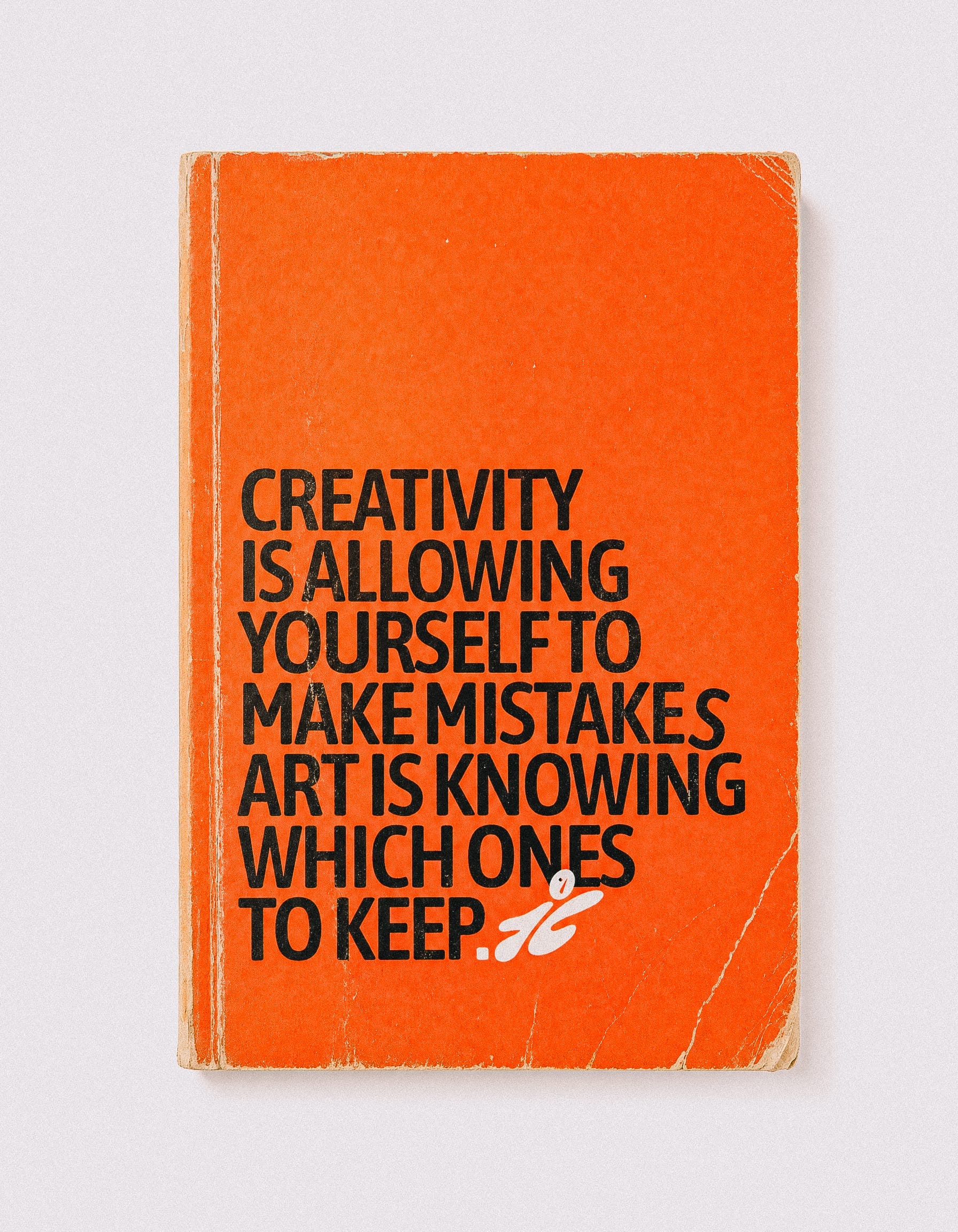
I did some digging and found some more "beautiful mistake" examples, some of which you may already heard somewhere:
Alexander Fleming (a bacteriologist at St. Mary's Hospital at the time) left a pile of dirty petri dishes on his desk before going on vacation. That's it. The origin story of penicillin. He basically came back from vacation and noticed a mold had grown on one of the dishes and that the mold had killed the bacteria around it. He didn't really plan any of this. He just forgot to clean up. Funny to say this, but the mess was basically the breakthrough here.
Or one of my favorite stories I've told many times: Spencer Silver, a chemist at 3M was trying to invent an incredibly strong glue. But he pretty much failed at it. What he made instead was an incredibly weak one. A glue that barely stuck to anything and could be peeled off without leaving a mark. It was a failure by every measure really. This useless weak glue sat around for years without any use, until a colleague named Art Fry (can't believe that's a real name) realized it was perfect for keeping bookmarks in his notebook without damaging the pages. Guess what happened next: The Post-it note! (this also relates to my example above about working with my junior designers, one man's failure might be the source of something new or special for someone else).
And another story I didn't even know till now: There was a French chemist named Édouard Bénédictus who dropped a glass flask in 1903. But instead of it shattering into pieces, the flask cracked and but held its shape. It turned out the flask had been coated with a layer of "cellulose nitrate" (basically he had some other stuff previously in it and this ended up being some accidental residue). Bénédictus didn't set out to invent safety glass. He just dropped his damn bottle. And now every car windshield in the world uses a version of what he found on his laboratory floor that day.
The pattern is always the same. Someone is trying to do one thing. They fail at it or they slip or they forget or they do something out of boredom. And in that gap between intention and what actually happens, something new (sometimes better or new) appears. Something that couldn't have been designed, because nobody was looking for it.
This is also the part that makes me think carefully about automation. I don't think the tools are bad, far from it. I use them constantly and they make a lot of my work faster, easier and more consistent. But consistency is unhelpful sometimes when it comes to truly creative problems.
An algorithm won't forget to wash the petri dishes, it won't let the wax drip unevenly and it certainly wouldn't make the mistake of making a weaker glue when being asked to make a strong one. A tool (or an algorithm for that matter) does what you tell it to do, precisely every single time. And that precision is what closes off so many unexplored pathways.
The argument for keeping your hands dirty isn't only about nostalgia for me, or even for the craft's sake (although many valid arguments in there too). But it's more about being involved in the accidents yourself, so to speak. A beautiful accident needs a real human mind and body. It needs someone who's tired, stuck, annoyed and just moving things around with no plan. It needs you to slip, forget and make a mistake just in the right moment.
Let's keep making beautiful mistakes 🖤
Thank you for reading.
Yours truly,
Tobias